Thursday, November 3, 2011

Notes on "Grace" Presentation at Reformation OC Conference 2011

Below are my notes from the presentation I gave on the topic of Grace at the Reformation OC Conference last weekend. Audio will be posted soon!

“Grace” in the Westminster Standards
Seth Stark
Ruling Elder, Communion Presbyterian Church
Reformation OC Conference 2011
October 28, 2011

INTRODUCTION
Grace. What does it mean? To whom is it imparted? On what basis does God extend it? What are the benefits of being the object of God’s grace?

GRACE: Defined
Grace is a free act of God, whereby He extends His love toward His elect in Christ.
2 Timothy 1:9, “who has saved us and called us with a holy calling, not according to our works, but according to His own purpose and grace which was given to us in Christ Jesus before time began,

Ephesians 1:4, 9, “just as He chose us in Him before the foundation of the world, that we should be holy and without blame before Him in love,...having made known to us the mystery of His will, according to His good pleasure which He purposed in Himself,”

Ephesians 1:5, 11, Having predestined us to adoption as sons by Jesus Christ to Himself, according to the good pleasure of His will...In Him also we have obtained an inheritance, being predestined according to the purpose of Him who works all things according to the counsel of His will,

John 6:37, 39, “All that the Father gives Me will come to Me, and the one who comes to Me I will by no means cast out....This is the will of the Father who sent Me, that of all He has given Me I should lose nothing, but should raise it up at the last day.

Acts 13:48, “Now when the Gentiles heard this, they were glad and glorified the word of the Lord. And as many as had been appointed to eternal life believed.

False systems of theology teach that God’s election is based on a foreseen faith and/or repentance or some other good work, and based on that foreknowledge, God elects those who would believe.

Grace cannot be based on foreseen faith.
Ephesians 2:8, “For by grace you have been saved through faith, and that not of yourselves; it is the gift of God,

Ephesians 2:10, “For we are His workmanship, created in Christ Jesus for good works, which God prepared beforehand that we should walk in them.

Ephesians 1:4, “just as He chose us in Him before the foundation of the world, that we should be holy and without blame before Him in love,

2 Peter 2:1, “elect according to the foreknowledge of God the Father, in sanctification of the Spirit, for obedience and sprinkling of the blood of Jesus Christ: Grace to you and peace be multiplied.

Grace cannot be based on good works.
Romans 11:4-7, “But what does the divine response say to him? “I have reserved for Myself seven thousand men who have not bowed the knee to Baal.” 5 Even so then, at this present time there is a remnant according to the election of grace. 6 And if by grace, then it is no longer of works; otherwise grace is no longer grace. But if it is of works, it is no longer grace; otherwise work is no longer work. 7 What then? Israel has not obtained what it seeks; but the elect have obtained it, and the rest were blinded.

Acts 5:31, “Him God has exalted to His right hand to be Prince and Savior, to give repentance to Israel and forgiveness of sins.

Romans 9:16, “So then it is not of him who wills, nor of him who runs, but of God who shows mercy.

Ephesians 2:9, “not of works, lest anyone should boast.

Grace cannot be based on any other thing in the creature.
1 Corinthians 4:7, “For who makes you differ from another? And what do you have that you did not receive? Now if you did indeed receive it, why do you boast as if you had not received it?

Romans 9:21, “Does not the potter have power over the clay, from the same lump to make one vessel for honor and another for dishonor?

Our Confessional Standards affirm these truths in many places.
Westminster Confession of Faith 3.5
Those of mankind that are predestinated unto life, God, before the foundation of the world was laid, according to His eternal and immutable purpose, and the secret counsel and good pleasure of His will, has chosen, in Christ, unto everlasting glory,[9] out of His mere free grace and love, without any foresight of faith, or good works, or perseverance in either of them, or any other thing in the creature, as conditions, or causes moving Him thereunto;[10] and all to the praise of His glorious grace.[11]

Westminster Larger Catechism
Q. 71. How is justification an act of God’s free grace?
A. Although Christ, by his obedience and death, did make a proper, real, and full satisfaction to God’s justice in the behalf of them that are justified;291 yet in as much as God accepteth the satisfaction from a surety, which he might have demanded of them, and did provide this surety, his own only Son,292 imputing his righteousness to them,293 and requiring nothing of them for their justification but faith,294 which also is his gift,295 their justification is to them of free grace.296

Q. 72. What is justifying faith?
A. Justifying faith is a saving grace,297 wrought in the heart of a sinner by the Spirit298 and Word of God,299 whereby he, being convinced of his sin and misery, and of the disability in himself and all other creatures to recover him out of his lost condition,300 not only assenteth to the truth of the promise of the gospel,301 but receiveth and resteth upon Christ and his righteousness, therein held forth, for pardon of sin,302 and for the accepting and accounting of his person righteous in the sight of God for salvation.303

Q. 73. How doth faith justify a sinner in the sight of God?
A. Faith justifies a sinner in the sight of God, not because of those other graces which do always accompany it, or of good works that are the fruits of it,304 nor as if the grace of faith, or any act thereof, were imputed to him for his justification;305 but only as it is an instrument by which he receiveth and applieth Christ and his righteousness.306

GRACE: BENEFITS
Having established what Grace is, and on what basis it is applied to the elect, let us examine the effects of Grace on those to whom it is given.

EFFECTUAL CALLING is a work of God’s Grace
John 5:25, “Most assuredly, I say to you, the hour is coming, and now is, when the dead will hear the voice of the Son of God; and those who hear will live.

Ephesians 1:18-20, “The eyes of your understanding being enlightened; that you may know what is the hope of His calling, what are the riches of the glory of His inheritance in the saints, 19 and what is the exceeding greatness of His power toward us who believe, according to the working of His mighty power 20 which He worked in Christ when He raised Him from the dead and seated Him at His right hand in the heavenly places,

2 Timothy 1:8-9, “Therefore do not be ashamed of the testimony of our Lord, nor of me His prisoner, but share with me in the sufferings for the gospel according to the power of God, 9 who has saved us and called us with a holy calling, not according to our works, but according to His own purpose and grace which was given to us in Christ Jesus before time began,

Romans 8:30, “Moreover whom He predestined, these He also called; whom He called, these He also justified; and whom He justified, these He also glorified.

2 Thessalonians 2:13-14, “But we are bound to give thanks to God always for you, brethren beloved by the Lord, because God from the beginning chose you for salvation through sanctification by the Spirit and belief in the truth, 14 to which He called you by our gospel, for the obtaining of the glory of our Lord Jesus Christ.

JUSTIFICATION is a work of God’s Grace
Romans 3:24, “Being justified freely by His grace through the redemption that is in Christ Jesus,

Acts 13:38-39, “Therefore let it be known to you, brethren, that through this Man is preached to you the forgiveness of sins; 39 and by Him everyone who believes is justified from all things from which you could not be justified by the law of Moses.

Ephesians 2:7-8, “that in the ages to come He might show the exceeding riches of His grace in His kindness toward us in Christ Jesus. 8 For by grace you have been saved through faith, and that not of yourselves; it is the gift of God,

ADOPTION is a work of God’s Grace
1 John 3:1, “Behold what manner of love the Father has bestowed on us, that we should be called children of God! Therefore the world does not know us, because it did not know Him.

Ephesians 1:5, “having predestined us to adoption as sons by Jesus Christ to Himself, according to the good pleasure of His will,

Galatians 4:4-5, “But when the fullness of the time had come, God sent forth His Son, born of a woman, born under the law, 5 to redeem those who were under the law, that we might receive the adoption as sons.

SANCTIFICATION is a work of God’s Grace
1 Corinthians 6:11, “And such were some of you. But you were washed, but you were sanctified, but you were justified in the name of the Lord Jesus and by the Spirit of our God.

2 Thessalonians 2:13, “But we are bound to give thanks to God always for you, brethren beloved by the Lord, because God from the beginning chose you for salvation through sanctification by the Spirit and belief in the truth,

BEING KEPT BY GOD is a work of God’s Grace
1 John 3:24, “Now he who keeps His commandments abides in Him, and He in him. And by this we know that He abides in us, by the Spirit whom He has given us.

Jeremiah 31:3, “The LORD has appeared of old to me, saying: ‘Yes, I have loved you with an everlasting love; therefore with lovingkindness I have drawn you.

1 Corinthians 1:8-9, “who will also confirm you to the end, that you may be blameless in the day of our Lord Jesus Christ. 9 God is faithful, by whom you were called into the fellowship of His Son, Jesus Christ our Lord.

Jeremiah 32:40, “And I will make an everlasting covenant with them, that I will not turn away from doing them good; but I will put My fear in their hearts so that they will not depart from Me.

1 Peter 1:5, “Who are kept by the power of God through faith for salvation ready to be revealed in the last time.

WE ARE KEPT FOR THE PURPOSE OF DOING GOOD WORKS which is a work of God’s Grace
Ephesians 2:10, “For we are His workmanship, created in Christ Jesus for good works, which God prepared beforehand that we should walk in them.

John 15:4-5, “Abide in Me, and I in you. As the branch cannot bear fruit of itself, unless it abides in the vine, neither can you, unless you abide in Me. 5 I am the vine, you are the branches. He who abides in Me, and I in him, bears much fruit; for without Me you can do nothing.

Ezekiel 36:26-27, “I will give you a new heart and put a new spirit within you; I will take the heart of stone out of your flesh and give you a heart of flesh. 27 I will put My Spirit within you and cause you to walk in My statutes, and you will keep My judgments and do them.

APPLICATION
Our election is based purely on God’s grace in Christ to us, from before time began. Those who are the objects of God’s grace are called, justified, adopted, sanctified, and kept for the purpose of doing good works, which themselves are gifts from God. What then do we contribute to our own salvation? Not. A. Thing.

Sola Gratia!

Tuesday, November 1, 2011

Reformation OC Conference: A Review

The dust has settled here in Orange County, following a very busy, but ultimately successful and encouraging weekend which saw the first ever Reformation OC Conference take place at Communion Presbyterian Church in Irvine. There are many positive things to be said for the Conference, and I doubt I'll have enough room to mention them all.
Conference Speaker Lindsay Brooks

First, the people: The first thing I observed as people started showing up was "I don't know any of these people!" That was actually very encouraging! It reminded me that there are many Reformed churches in the Orange County area and many more saints who hold the Doctrines of Grace dear than those who meet together every Lord's Day at Communion Presbyterian Church.

Second, the speakers. Both main session speakers and breakout session speakers were excellent! On Friday, Kent Moorlach kicked us off with an early breakout session on the topic of Justification. He compared the sermons we find in the Book of Acts to what the Reformed Churches and the Roman Catholic Church teaches, demonstrating that it is the Reformed Church which follows the apostolic teaching found in Scripture. Next, during our first main session, Christopher Neiswonger gave an excellent overview of the history of the Christian Church, with a special emphasis on the Reformed churches. This was followed by our first regular breakout session. One of our speakers had to cancel at the last minute, so I was asked to substitute and talk on the subject of Grace in the Westminster Standards. I got a lot of nice feedback from the folks who came to my session. While I was presenting on that topic, Lindsay Brooks was presenting on the subject of music in worship, and Sam Welbaum was talking about the Doctrine of Sin. I only heard good things about both these talks, so I look forward to hearing them, once they are made available. Finally on Friday, we heard from Pastor Paul Viggiano on the Apologetics of the Reformation. Having studied at Biola, where presuppositionalism is not taught, it was refreshing to hear a consistently presuppositional apologetic put forth. Friday evening ended with a group of folks from the conference fellowshipping over pizza and Newcastle at a pizzeria around the corner (for more on that, see my "Third" point below). 
Rev. Kent Moorlach

Saturday's sessions were equally as encouraging. The day got started off by Rev. Kent Moorlach speaking on the subject of the New Speak of Liberal Christianity. He challenged us all to maintain confessional fidelity, especially when it comes to admitting men to our presbyteries. Following that, Rev. Danny Hyde spoke on Welcome to a Reformed Church, which chronicled some of his own journey from conversion to the Reformed Church, as well as expounding the things that make us different from the rest of the evangelical world. After Rev. Hyde spoke, there was another breakout session two different talks (our third speaker for this breakout session was providentially hindered from being there): Rev. Hyde spoke on the doctrine of the Holy Spirit in the Reformed Tradition while Rev. David Stark spoke on the preservation of Scripture. I attended Rev. Stark's talk, and must say his defense of the traditional Greek text of the New Testament sparked a lot of post-talk conversations.

After a break for lunch, the conference resumed with Rev. Philip DeCoursey speaking on the importance of the Word of God in the Protestant Churches. The Conference concluded with a final breakout session. Rev. Jonathan Moersch spoke on the difference between infusion and imputation. Rev. David Stark spoke on the importance of the Lord's Day Sabbath for the Christian Church. Rev. John Sawtelle spoke about Ulrich Zwingli and his example being appropriate for 21st century reformed pastors.
Rev. David Stark

Third, the fellowship. Friday evening, after the conference concluded, a number of the speakers and attendees went out for dinner to a local pizzeria. This was a great time of fellowship where I was able to meet many pastors and members of churches in my area. But, the fellowship wasn't limited to after the conference. Just about everyone who walked through the door was friendly, and there were a lot of introductions being made the whole time. The fellowship of the saints was one of the most enjoyable aspects of the conference!

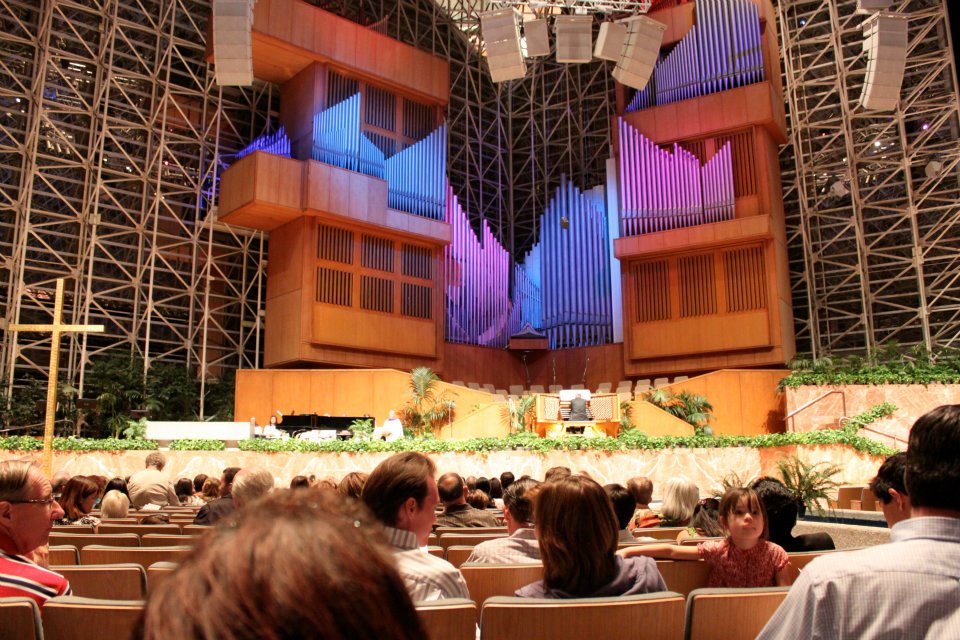
Inside the Crystal Cathedral
Sunday evening, conference attendees were invited to participate in a Reformation Sunday Service at the Crystal Cathedral of Garden Grove. Rev. Kent Moorlach was invited to preach at that evening service on the topic of Soli Deo Gloria. There were so many people in attendance, that the ushers had to make extra copies of the order of worship! Apparently, the attendance was double what they were expecting. Praise God that the Gospel was preached in that building!
Rev. Kent Moorlach and Lindsay Brooks

There were a few bumps in the road, but having been through it once, we are better prepared for next year. And, based on how many people are already expressing interests in another conference, Lord willing, there will be a next year!

One final, closing note. I would be remiss in my account of the conference, if I didn't mention the many tireless volunteers from Communion Presbyterian Church who gave their time and energy to make sure everything behind the scenes ran smoothly. From the registration table, to the snacks, to our own church's table and everything else: the people who make Communion Presbyterian a wonderful church also made this Conference a wonderful event!

I look forward to seeing you all at next year's Reformation OC Conference!

Tuesday, October 25, 2011

The ARP was not a "Wave of Reformation" of the PCUSA

The Aquila Report has republished an article by Carmen Fowler LaBerge of The Layman Online discussing denominational reformation. In as far as the article emphasizes a return to confessionalism, it's a good article. However, one thing ought to be clarified: When LaBerge lists waves of reformation that have sprouted out of the PCUSA, the following denominations are listed: The Orthodox Presbyterian Church, the Associate Reformed Presbyterian Church, the Presbyterian Church in America, and the Evangelical Presbyterian Church. But, the ARP was never a part of the PCUSA. The Associate Reformed Presbyterian Church split from the Church of Scotland in the 1700s and the Associate Presbyterians in the United States were never a part of the Presbyterian Church USA.


You can read more about the history of the ARP here.

Monday, October 24, 2011

WCF Sunday School Class, Week 20: Assurance

Below are links to the materials for last Sunday's Adult Sunday School class on the Westminster Confession of Faith at Communion Presbyterian Church. It should be noted that the "Questions" in the lecture notes refer to David Dickson's Truth's Victory Over Error.

Chapter 18: Assurance Handout
Chapter 18: Assurance Handout with full Scripture Proofs
Lecture Notes (keyed to Truth's Victory Over Error, Chapter 18)

Materials related to past classes can be accessed by clicking here: Westminster Confession of Faith Sunday School Class.

Churchmanship is not Penmanship by Dean Turbeville

The Aquila Report has posted an excellent little article on the important, but much neglected, discipline of churchmanship. Rev. Dean Turbeville (ARP) makes a strong argument for this forgotten practice:


Churchmanship is also a crucible of the soul and battlefield for the kingdom. Paul’s language to the Galatians is almost war-like. And nobody’s light burned brighter for the maintenance of the visible church in faithfulness like Jesus Christ, of whom it was said, “zeal for the Lord’s House consumes him (John 2:17).”
 Rev. Turbeville goes on to list seven practical steps "toward obedient churchmanship," including:
Both large church officers and small church officers are presbyters and should contribute in this way. No false modesty or unbiblical inferiority complex should thwart the vows we all made at our ordination. And the same can be said for ordained seminary professors: it is your church too!
 and
Love your fellow presbyters as brothers, but be willing at any point to do the right thing for Christ and the church, even if your best friend thinks differently.
 The entire article is worth reading, and can be found here:  Churchmanship is not penmanship!

Friday, October 21, 2011

He Descended into Hell

At this week's Bible study, a question was raised concerning the belief that Christ descended into Hell. Our Catechism teaches us the following (I've bolded the relevant wording and Scripture proofs):

Q. 50. Wherein consisted Christ's humiliation after his death?
A. Christ's humiliation after his death consisted in his being buried,1 and continuing in the state of the dead, and under the power of death till the third day;2 which hath been otherwise expressed in these words, He descended into hell.
1 1 Corinthians 15:3-4. For I delivered unto you first of all that which I also received, how that Christ died for our sins according to the scriptures; And that he was buried, and that he rose again the third day according to the scriptures.
2 Psalm 16:10. For thou wilt not leave my soul in hell; neither wilt thou suffer thine Holy One to see corruption.
Acts 2:24-27, 31.
Whom God hath raised up, having loosed the pains of death: because it was not possible that he should be holden of it. For David speaketh concerning him, I foresaw the Lord always before my face, for he is on my right hand, that I should not be moved: Therefore did my heart rejoice, and my tongue was glad; moreover also my flesh shall rest in hope: Because thou wilt not leave my soul in hell, neither wilt thou suffer thine Holy One to see corruption.... He seeing this before spake of the resurrection of Christ, that his soul was not left in hell, neither his flesh did see corruption.
Romans 6:9.
Knowing that Christ being raised from the dead dieth no more; death hath no more dominion over him.
Matthew 12:40.
For as Jonas was three days and three nights in the whale's belly; so shall the Son of man be three days and three nights in the heart of the earth.

In their commentary on the Larger Catechism, G. I. Williamson and J. G. Vos, write this, concerning Question 50:

What is meant by the expression in the Apostles' Creed which Says, "He descended into hell"?
This expression has been understood in various ways. Some hold that Christ literally descended into hell, not the hell of the devil and the wicked angels, but a place where the Old Testament saints were thought to be waiting. There, they say, he preached to those spirits and opened the way for them to enter heaven. THis interpretation, which is held by the Roman Catholic Church and by some Protestants, is unsound and is based on a misunderstanding (wrong interpretation) of 1 Peter 3:18-20. Some Protestants hold that the words "He descended into hell" refer to Christ's suffering on the cross, that is, that he descended into hell, not as a place, but as an experience of suffering. While this idea is doctrinally sound, it is historically unwarranted because the word translated "hell" in the Apostles' Creed in not Gehenna (the place of punishment) but Hades (the realm of death). Our catechism teaches that the words "He descended into hell" refer to Christ's being buried, and continuing under the power of death for a time, the word hell being understood as "the realm of the power of death." (pages 112-3).